What problems does NotionCMS solve?
Using the Notion API for SSG is simple right?
- Notion is great. It provides a very solid API but it isn’t super easy to use for SSG.
- It’s designed to be broadly applicable, following Notion philosophy.
📢
Sidebar: Why pre-render your website? SEO & Performance. When you have a lot of content, pre-rendering is even more important (the ROI is higher).
Notion API is powerful, but not easy to use for this case.
An example:
- Many API calls are required.
- query database (1x)
- query each individual page for its content
- parse all page content blocks and transform each into desired format
- 🔁 repeat for each page
- When a project is spread over many Notion pages getting fresh content when developing can take long!
Wait, can’t we use concurrency to make # of pages irrelevant?
- rate limits.
p-mapmakes sure you don’t get 429s but makes fetching all data take longer. - pages with lots of blocks (or dbs with lots of pages) use pagination and require sequential requests
- rate limits.
- Technical overhead of implementing a custom solution.
Existing Solutions
Notion-client and React-Notion-X
Notion-X
- React only
- 1-to-1 block to component mapping
- unofficial API (reverse engineered)
- Mature, robust, well tested
- fast out of the box (tip: unofficial API is more performant)
NotionCMS
- Agnostic
- custom per block renderers
- official API - versioned, stable, no breaking changes
- new, not all blocks have renders (but just build one!)
Different approaches.
NotionCMS generates a data object that holds static content. You can feed this into your reactivity framework but the blocks are not “components” like react-notion-x is.
This makes NotionCMS more flexible.
How NotionCMSworks
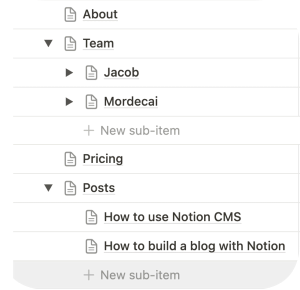
routes = [
  '/about',
  '/team',
  '/team/jacob',
  '/team/mordecai',
  '/pricing',
  '/posts',
  '/posts/how-to-use-notion-cms',
  '/posts/how-to-build-a-blog-with-notion'
]NotionCMSreigns in the power of Notion API by trading off flexibility for a defined handshake with the API.- We do this is to require the use of a DB structured in a specific way.
- It’s explicit, but also generic enough to meet most “webby” use cases (that require DAGs).
- This structure lets us apply patterns that make accessing Notion data very easy via
NotionCMSAPI.